
In order to conserve natural resources and economize energy, weight reduction has been the main focus of automobile manufacturers in the present scenario. Weight reduction can be achieved primarily by the introduction of better material, design optimization and better manufacturing processes. The suspension leaf spring is one of the potential items for weight reduction in automobiles as it accounts for 10% - 20% of the unsprung weight. This achieves the vehicle with more fuel efficiency and improved riding qualities. The introduction of composite materials was made it possible to reduce the weight of leaf spring without any reduction on load carrying capacity and stiffness. Since, the composite materials have more elastic strain energy storage capacity and high strength to weight ratio as compared with those of steel, multi-leaf steel springs are being replaced by mono-leaf composite springs. The composite material offer opportunities for substantial weight saving but not always be cost-effective over their steel counterparts.
Showing posts with label MECHANICAL. Show all posts
Showing posts with label MECHANICAL. Show all posts
C V T
After more than a century of research and development, the internal combustion (IC) engine is nearing both perfection and obsolescence: engineers continue to explore the outer limits of IC efficiency and performance, but advancements in fuel economy and emissions have effectively stalled. While many IC vehicles meet Low Emissions Vehicle standards, these will give way to new, stricter government regulations in the very near future. With limited room for improvement, automobile manufacturers have begun full-scale development of alternative power vehicles. Still, manufacturers are loath to scrap a century of development and billions or possibly even trillions of dollars in IC infrastructure, especially for technologies with no history of commercial success. Thus, the ideal interim solution is to further optimize the overall efficiency of IC vehicles.
One potential solution to this fuel economy dilemma is the continuously variable transmission (CVT), an old idea that has only recently become a bastion of hope to automakers. CVTs could potentially allow IC vehicles to meet the first wave of new fuel regulations while development of hybrid electric and fuel cell vehicles continues. Rather than selecting one of four or five gears, a CVT constantly changes its gear ratio to optimize engine efficiency with a perfectly smooth torque-speed curve. This improves both gas mileage and acceleration compared to traditional transmissions.
The fundamental theory behind CVTs has undeniable potential, but lax fuel regulations and booming sales in recent years have given manufacturers a sense of complacency: if consumers are buying millions of cars with conventional transmissions, why spend billions to develop and manufacture CVTs?
Although CVTs have been used in automobiles for decades, limited torque capabilities and questionable reliability have inhibited their growth. Today, however, ongoing CVT research has led to ever-more robust transmissions, and thus ever-more-diverse automotive applications. As CVT development continues, manufacturing costs will be further reduced and performance will continue to increase, which will in turn increase the demand for further development. This cycle of improvement will ultimately give CVTs a solid foundation in the world’s automotive infrastructure.
Cryogenics
The term “Cryogenics” originates from Greek word which means creation or production by means of cold. As prices for energy and raw materials rise and concern for the environment makes safe waste disposal difficult and Costly, resource recovery becomes a vital matter for today’s business. Cryogenic grinding technology can efficiently grind most tough materials and can also facilitate Cryogenic recycling of tough composite materials and multi component scrap. The heart of this technology is the CRYO-GRIND SYSTEM. It employs a cryogenic process to embrittle and grind materials to achieve consistent particle size for a wide range of products. The cryogenic process also has a unique capability for recycling difficult to separate composite materials.
Cryogenic grinding is a method of powdering herbs at sub-zero temperatures ranging from 0 to minus 70°F. The herbs are frozen with liquid nitrogen as they are being ground. This process does not damage or alter the chemical composition of the plant in any way. Normal grinding processes which do not use a cooling system can reach up to 200°F. These high temperatures can reduce volatile components and heat-sensitive constituents in herbs. The cryogenic grinding process starts with air-dried herbs, rather than freeze-dried herbs.
Solid materials are ground or pulverized by way of hammer mills, attrition mills, granulators or other equipment. A smaller particle size is usually needed to enhance the further processing of the solid, as in mixing with other materials. A finer particle also helps in melting of rubber and plastics for molding. However, many materials are either very soft or very tough at room temperatures. By cooling to cryogenic temperatures with liquid nitrogen, these may be embrittled and easily fractured into small particles.
A scientifically controlled study using four herbs was conducted at Frontier Herbs in the Fall of 1996, comparing cryogenic grinding methods with normal grinding methods. The herbs tested included feverfew, goldenseal, valerian and echinacea. In all cases the cryogenically ground herb contained greater amounts of the constituents tested. Feverfew herb showed the greatest difference, with the cryogenically ground herb containing 21.8% higher levels of parthenolide, the primary active constituent. Valerian root showed an 18.7% increase in valerenic acid when cryogenically ground. Goldenseal root showed a 16.4% increase in berberine and 10.7% increase in hydrastine. Lastly, Echinacea purpurea root showed a 12.1% increase in total phenolic content in the cryogenically ground root. Test results were obtained by HPLC (high performance liquid chromatography) methods.
Computer Aided Process Planning (CAPP)
Technological advances are reshaping the face of manufacturing, creating paperless manufacturing environments in which computer automated process planning (CAPP) will play a preeminent role. The two reasons for this effect are: Costs are declining, which encourages partnerships between CAD and CAPP developers and access to manufacturing data is becoming easier to accomplish in multivendor environments. This is primarily due to increasing use of LANs; IGES and the like are facilitating transfer of data from one point to another on the network; and relational databases (RDBs) and associated structured query language (SQL) allow distributed data processing and data access.
With the introduction of computers in design and manufacturing, the process planning part needed to be automated. The shop trained people who were familiar with the details of machining and other processes were gradually retiring and these people would be unavailable in the future to do process planning. An alternative way of accomplishing this function was needed and Computer Aided Process Planning (CAPP) was the alternative. Computer aided process planning was usually considered to be a part of computer aided manufacturing. However computer aided manufacturing was a standalone system. In fact a synergy results when CAM is combined with CAD to create a CAD/CAM. In such a system CAPP becomes the direct connection between design and manufacturing.
Moreover, the reliable knowledge based computer-aided process planning application¾Met CAPP software looks for the least costly plan capable of producing the design and continuously generates and evaluates the plans until it is evident that non of the remaining plans will be any better than the best one seen so far. The goal is to find a useful reliable solution to a real manufacturing problem in a safer environment. If alternate plans exist, rating including safer conditions is used to select the best plans
Circuit and Safety Analysis System (CSAS)
Success is all about being in the right place at the right time ….. and the axiom is a guiding principle for designers of motorsport circuits. To avoid problems you need know where and when things are likely to go wrong before cars turn a wheel –and anticipating accidents is a science.
Take barriers, for example .there is little point erecting them in the wrong place –but predicting the right place is a black art. The FIA has developed bespoke software, the Circuit and Safety Analysis System (CSAS), to predict problem areas on F1 circuits.
Where and when cars leave circuits is due to the complex interaction between their design, the driver’s reaction and the specific configuration of the track, and the CSAS allows the input of many variables-lap speeds ,engine power curves, car weight changes, aerodynamic characteristics etc –to predict how cars may leave the circuit at particular places. The variables are complex. The impact point of a car continuing in a straight line at a corner is easy to predict, but if the driver has any remaining control and alters the car’s trajectory, or if a mechanical fault introduces fresh variables, its final destination is tricky to model.
Modern tyre barriers are built of road tyres with plastic tubes sandwiched between them. The side facing the track is covered with conveyor belting to prevent wheels becoming snagged and distorting the barrier. The whole provides a deformable ‘cushion’ a principle that has found its way to civilian roads. Barriers made of air filled cells, currently under investigation may be the final answer. Another important safety factor is the road surface. Racing circuits are at the cutting edge of surface technology, experimenting with new materials for optimum performance.BUGATTI VEYRON

Not just a super car that carries on the name of racing driver Pierre Veyron, who, while racing for the original Bugatti car manufacturer, won the 24 hours of Le Mans in 1939, Bugatti Veyron 16.4 is the second fastest car in the world and the most powerful, it can easily pass as a super hero`s car like Batman. It has the fastest acceleration speed, reaching 60 mph in 2.6 seconds.

Endowed with W16 engine-16 cylinders in 4 banks of 4 cylinders fed by four turbochargers, a dual-clutch DSG computer-controlled manual transmission, the Veyron has a length is 4462 mm (175.8 in) a wide of 1998 mm (78.7 in) and hight of 1206 mm (47.5 in). Counting a sum of 10 radiators, for the engine cooling system, for transmission oil, a heat exchanger for the air to liquid intercoolers, for engine oil etc., the car has a power to weight ratio of 529 bhp/tonne.

If we talk about performance we are dazzled by this supercars power to reach 200 and 300 km/h (124 and 186 mph) in 7.3 and respectively 16.7 seconds, wining for herself the name of the quickest-accelerating production car in history. If we count the fact that the top speed of Bugatti Veyron is 253.2 miles per hour (407.5 km/h), a speed limited electronically to prevent tire damage (it can run even faster) we can understand why this spectacular car must consume 40.4 L/100 km (4.82 mpg) when it`s running at top speed and in city driving 24.1 L/100 km.
A model drove by superstars like Tom Cruise, couldn`t name itself cheap, rising the Bugatti Veyron at least of $1,700,000, a price that measures it`s quality. Many new designs has been released since 2006, the color might have changed, but the speed and power remain the same.
Biomechatronic
The objective of the work describe in this paper is to develop an artificial hand aimed at replicating the appearance and performance of the natural hand the ultimate goal of this research is to obtain a complete functional substitution of the natural hand. This means that the artificial hand should be felt by the user as the part of his/her own body (extended physiological proprioception(EPP) ) and it should provide the user with the same functions of natural hand: tactile exploration, grasping , and manipulation (“cybernetic” prosthesis). Commercially available prosthetic devices, as well as multifunctional hand designs have good (sometimes excellent) reliability and robustness, but their grasping capabilities can be improved. It has been demonstrated the methodologies and knowledge developed for robotic hands can be apologies and knowledge developed for robotic hands can be applied to the domain of prosthetics to augment final performance. The first significant example of an artificial hand designed according to a robotic approach is the Belgrade/USC Hand. Afterwards, several robotic grippers and articulated hands have been developed, for example the Stanford/JPL hand and the Utah/MIT hand which have achieved excellent results. An accurate description and a comparative analysis of state of the art of artificial hands can be found in. These hands have achieved good performance in mimicking human capabilities, but they are complex devices requiring large controllers and their mass and size are not compatible with the strict requirements of prosthetic hands.
In fact, the artificial hands for prosthetics applications pose challenging specifications and problems, as is usually the case for devices to be used for functional replacement in clinical practice. These problems have forced the development of simple, robust, and reliable commercial prosthetic hands, as the Otto Brock Sensor Hand prostheses which is widely implanted and appreciated by users. The Otto Bock hand has only one degree of freedom(DOF), it can move the fingers at proportional speed from 15-130 mm/s and can generate grip force up to 100 N.
According to analysis of the state of art, the main problems to be solved in order to improve the performance of prosthetic hands are
1) lack of sensory information gives to the amputee;
2) lack of “natural” command interface;
3) limited grasping capabilities;
4) Unnatural movements of fingers during grasping.
In order to solve these problems, we are developing a biomechatronic hand, designed according to mechatronic concepts and intended to replicate as much as possible the architecture and the functional principles of the natural hand.
The first and second problems can be addressed by developing a “natural” interface between the peripheral nervous system (PNS) and the artificial device (i.e., a “natural” neural interface (NI) to record and stimulate the PNS in a selective way. The neural interface is the enabling technology for achieving ENG-based control of the prostheses, i.e., for providing the sensory connection between the artificial hand and the amputee. Sensory feedback can be restored by stimulating in an appropriate way user’s afferent nerves after characterization of afferent PNS signals in response to mechanical and proprioceptive stimuli.
The research described in this paper is focused on the third and the fourth points. In general, cosmetics requirements force to incorporate the entire device in a glove and to keep size and mass of the entire device comparable to that of the human hand. It turns out that the combination of robust design goals, cosmetics, and limitation of available components, can be matched only with a drastic reduction of DOF’s, as compared to those of the natural hand. In fact, in prosthetic hands active bending of joints is restricted only to two or three joints (metacarpo-pha-langeal joints of the thumb, of the index and of the middle finger), while the other joints are fixed. Due to the lack of DOF’s prostheses are characterized by low grasping functionality and, thus they do not allow adequate encirclement of objects in comparison to the human hand ; low flexibility and low adaptivity of artificial fingers leads to instability of the grasp in presence of an external perturbation, as illustrated in. In conclusion, commercial prostheses have been designed to be simple, robust and low cost, at the expense of their grasping ability.
This paper presents a novel multi-DOF hand several active joints, which is designed to obtain better grasping performance and natural fingers movements. The hand is designed according to a biomechatronic approach: miniature actuators and Hall-effect position sensors are embedded in the hand structure in order to enable the control of available DOF’s. This paper describes a prototype of the artificial hand which has been designed, fabricated, and tested in vitro, in order to assess the feasibility of the proposed approach.
Robotics
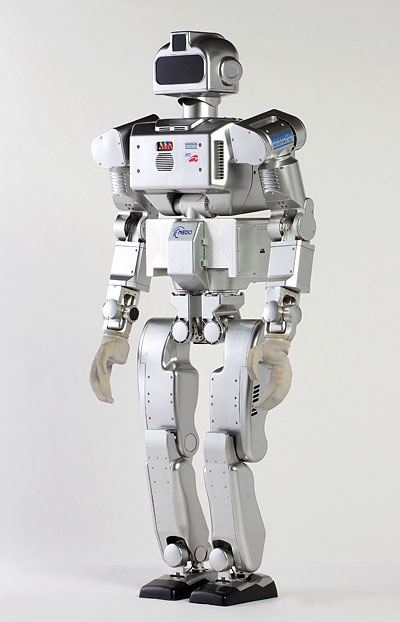
Robots have always had a fascination in our mind. With their various applications in various fields, they have become a common part in our daily life. They are meant to ease our work and increase our comfort of living.
The term ‘robot’ got prominence way back in the 1950s when Karl Capek in his play Rossum’s Universal Robots denoted the birth of a superior race that had intelligence similar to that of humans.
As Robots come in various forms and have application in various fields defining a Robot becomes that much difficult. There are various definitions for the term Robot. Some of them are:
“Force through intelligence”.
“An automatic device that performs functions normally ascribed to humans or a machine in the form of a human”.
The most accepted definition of a Robot provided by the Robotics Institute of America in 1979 is that:
“A robot is a reprogrammable multifunctional manipulator designed to move material, Parts, tools or specialized devices through variable programmed motions for the Performance of a variety of tasks”.
Robotics is that branch which involves with the study and applications of Robots. The goal of Robotics is to mimic natural world as closely as possible. Robotics is a relatively new field of engineering (about approximately 50 years old) and is finding many applications in different areas.
With growing developments in the field of mechatronics and mathematic modeling, Robotics has come a long way. From an iron piece that could move only a few inches, there are now machines capable of jumping from high rise buildings, detecting landmines, performing complicated operations, and troubleshooting.
Air cars
Have you been to the gas station this week? Considering that we live in a very mobile society, it's probably safe to assume that you have. While pumping gas, you've undoubtedly noticed how much the price of gas has soared in recent years. Gasoline which has been the main source of fuel for the history of cars, is becoming more and more expensive and impractical (especially from an environmental standpoint). These factors are leading car manufacturers to develop cars fueled by alternative energies. Two hybrid cars took to the road in 2000, and in three or four years fuel-cell-powered cars will roll onto the world's highways.
While gasoline prices in the United States have not yet reached their highest point ($2.66/gallon in 1980), they have climbed steeply in the past two years. In 1999, prices rose by 30 percent, and from December 1999 to October 2000, prices rose an additional 20 percent, according to the U.S. Bureau of Labor Statistics. In Europe, prices are even higher, costing more than $4 in countries like England and the Netherlands. But cost is not the only problem with using gasoline as our primary fuel. It is also damaging to the environment, and since it is not a renewable resource, it will eventually run out. One possible alternative is the air-powered car.
Air powered cars runs on compressed air instead of gasoline. This car is powered by a two cylinder compressed engine. This engine can run either on compressed air alone or act as an IC engine. Compressed air is stored in glass or fiber tanks at a pressure of 4351 psi
Subscribe to:
Posts (Atom)